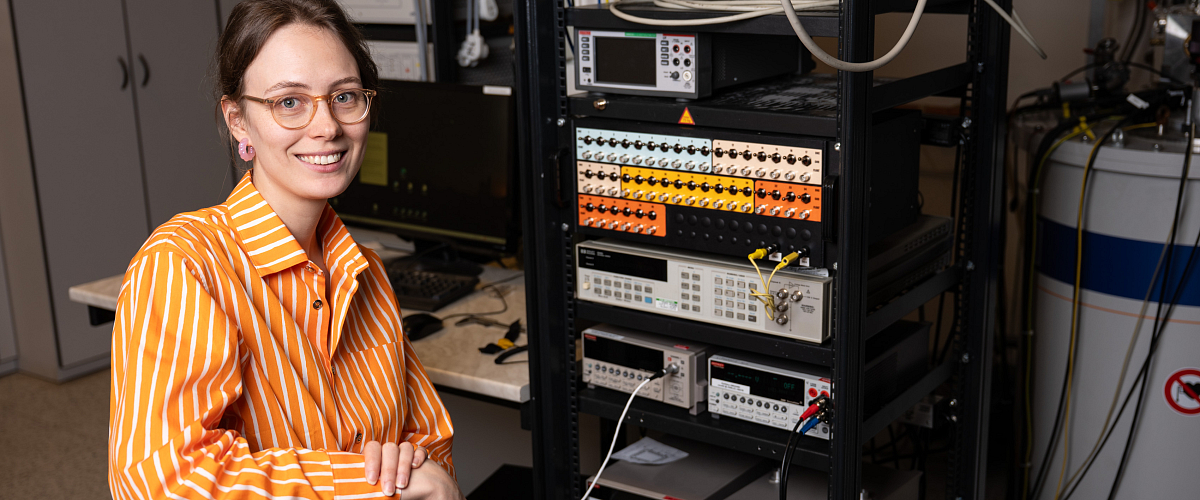
Miina Leiviskä: “Having a joint mentorship between theory and experiment was a big draw for me”
The CzechNanoLab infrastructure is a vital resource for cutting-edge materials research, currently utilized by several international experts. Among these, Dr. Miina Leiviskä, a Postdoctoral Fellow supported by the MSCA COFUND program at FZU. Her fascinating work on altermagnets and magnonics blends new physics with the potential for future computing. We now bring you a detailed interview with Dr. Leiviskä to delve deeper into her research utilizing these advanced instruments.
Your current research project combines altermagnets and spintronics, respectively magnonics – all very new and exciting areas of physics. Can you tell us more?
Spintronics, which encompasses my research, is an area of study that explores using the spin of electrons instead of their charge to process, store, and transfer information. For example, in memory applications, this has the potential to be more energy-efficient and non-volatile, meaning real-time data wouldn’t be lost even if power were cut off, let’s say if you accidentally unplugged your computer or suffered a blackout.
Could this be useful in extreme environments, like space missions where computers could then be turned off in hibernation or adverse environments?
Probably yes. Another possibly useful attribute of the antiferromagnetic and altermagnetic materials that I have researched is that they have a special robustness against external magnetic field perturbations, as they have no net magnetic moment. This is unlike in ferromagnetic materials, which do have a net magnetic moment, which are commonly used in spintronics applications.
The whole interview can be found here.