UHV Preparation and Analytical System - Low Energy Electron Microscope SPECS FE-LEEM P90
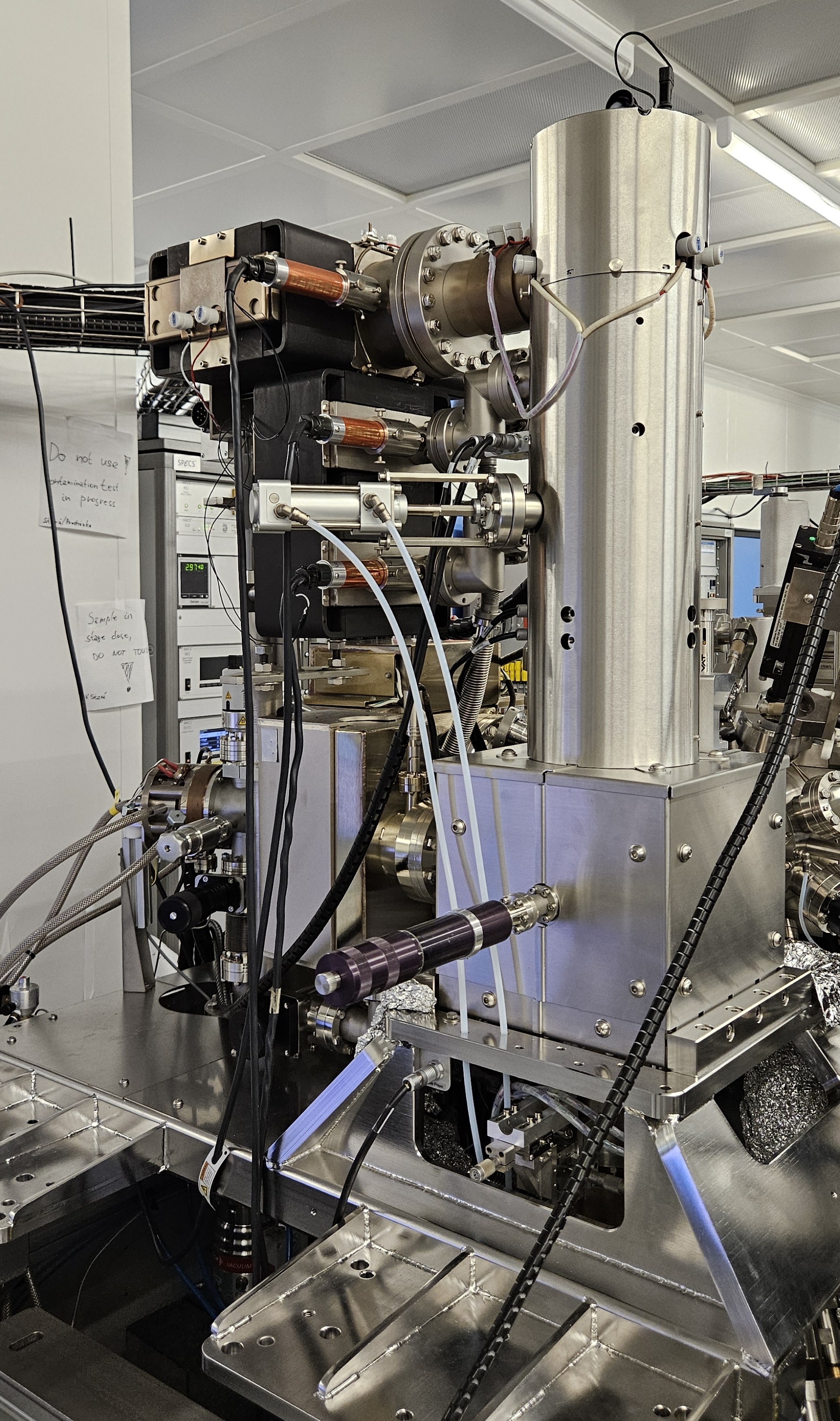
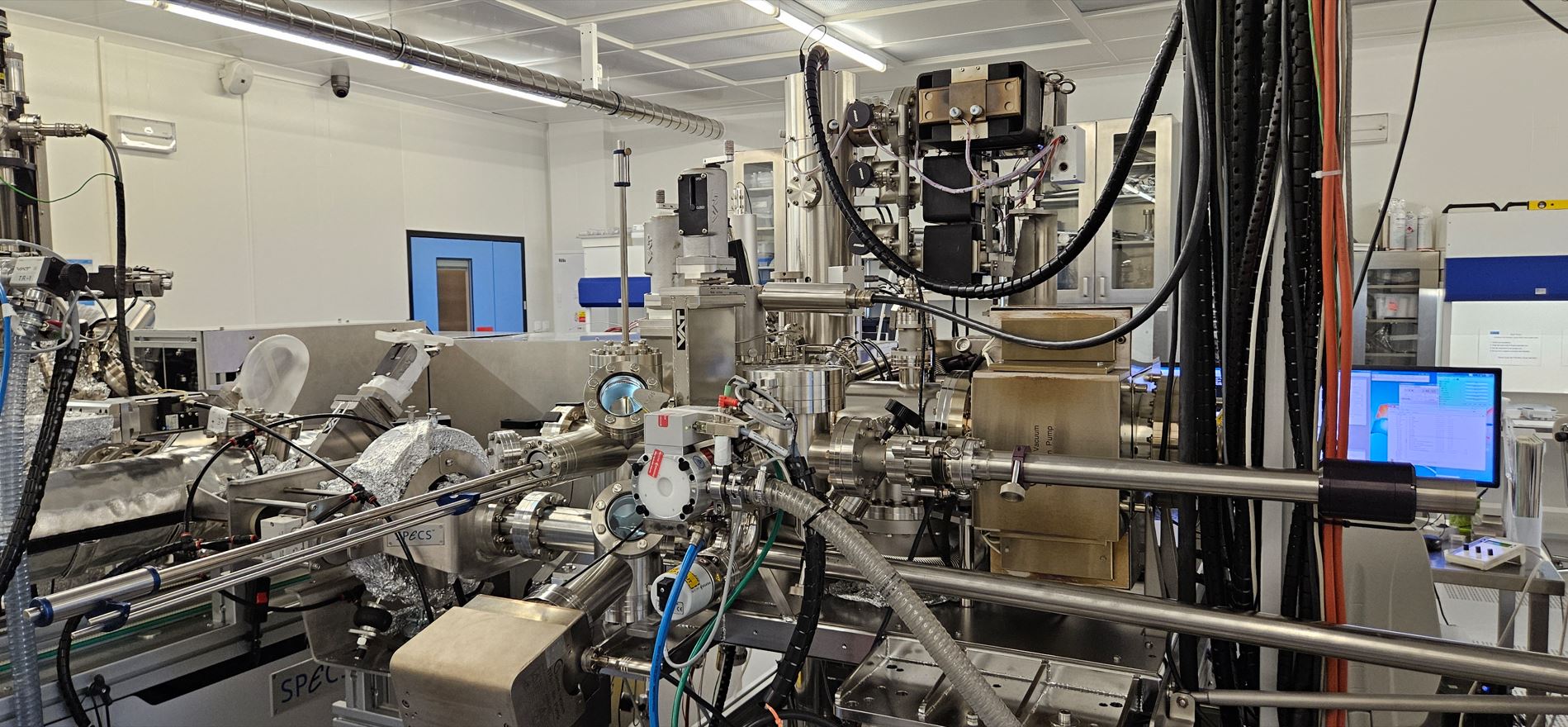
Low energy electron microscope (LEEM) is one of the instruments of the UHV-Cluster, which combines preparation and in-situ analysis by several complementary methods for the characterization of surfaces and thin films. The LEEM instrument utilizes low energy, elastically backscattered electrons to image surfaces with high spatial and temporal resolution. Advantages of LEEM over other surface imaging techniques are real-time imaging capability and existing several unique contrast mechanisms for image formation. LEEM is a powerful tool for studying the dynamic and static properties of surfaces and thin films, phase transitions, reactions, structure and morphology, and more.
Specification
- Photoelectron/Low Energy Electron Microscopy with a resolution down to 10 and 5 nanometers, respectively.
- Real-time imaging of surface processes (kinetics of the growth of layers and reactions) combined with micro-diffraction and UV spectroscopic modes for surface lattice and the electronic structure determination, respectively.
- Possibility to measure up to sample temperature of 1500 K, during evaporation or gas dosing.
- Equipment: Hg lamp, He UV source (He-I, He-II), cold-cathode electron gun (15keV), electron beam heater. Independent preparation chamber and load-lock with sample storage. Port for effusion cell separated by gate valve from analytical chamber.
Gallery
Publications
PROCHÁZKA, P.; STARÁ, V.; PLANER, J.; SKÁLA, T.; ČECHAL, J., 2025: Structure of epitaxial heteromolecular bilayers probed by low-energy electron microscopy. SURFACES AND INTERFACES 62, p. 106251-1 - 106251-8, doi: 10.1016/j.surfin.2025.106251 (UHV-LEEM, UHV-XPS, UHV-SPM)
Prochazka, P.; Frezza, F.; Sánchez-Grande, A.; Carrera, M.; Chen, QF.; Stará, V.; Kurowská, A.; Curiel, D.; Jelínek, P.; Cechal, J., 2025: Monitoring On-Surface Chemical Reactions by Low-Energy Electron Microscopy: from Conformation Change to Ring Closure in 2D Molecular Gas. CHEMISTRY 31 (20), p. e20250056 - 6, doi: 10.1002/chem.202500561 (UHV-LEEM, UHV-SPM)
KRAJŇÁK, T.; STARÁ, V.; PROCHÁZKA, P.; PLANER, J.; SKÁLA, T.; BLATNIK, M.; ČECHAL, J., 2024: Robust Dipolar Layers between Organic Semiconductors and Silver for Energy-Level Alignment. ACS APPLIED MATERIALS & INTERFACES 16 (14), p. 18099 - 13, doi: 10.1021/acsami.3c18697 (UHV-LEEM, UHV-XPS, UHV-SPM)
PROCHÁZKA, P.; ČECHAL, J., 2024: ProLEED Studio: software for modeling low-energy electron diffraction patterns. JOURNAL OF APPLIED CRYSTALLOGRAPHY 57 (1), p. 187 - 7, doi: 10.1107/S1600576723010312 (UHV-LEEM)
JAKUB, Z.; TRLLOVÁ SHAHSAVAR, A.; PLANER, J.; HRŮZA, D.; HERICH, O.; PROCHÁZKA, P.; ČECHAL, J., 2024: How the Support Defines Properties of 2D Metal-Organic Frameworks: Fe-TCNQ on Graphene versus Au(111). JOURNAL OF THE AMERICAN CHEMICAL SOCIETY 146 (5), p. 3471 - 12, doi: 10.1021/jacs.3c13212 (UHV-MBE2, UHV-LEEM, UHV-XPS, UHV-SPM)
Kurowská, A., 2023: 2D metal-organic frameworks from organic carbonitrile molecules on weakly interacting substrates. MASTER'S THESIS, p. 1 - 61 (UHV-MBE2, UHV-LEEM, UHV-SPM, UHV-XPS)
David, J., 2023: Preparation of elementary 2D materials and heterostructures. MASTER'S THESIS, p. 1 - 69 (UHV-LEEM, UHV-XPS, UHV-SPM)
Jeřábek, F., 2023: Microscopic and spectroscopic analysis of elementary 2D materials. BACHELOR'S THESIS, p. 1 - 42 (UHV-LEEM, UHV-SPM)
Makoveev, A. O., 2023: Molecular self-assembly on surfaces: the role of coverage, surface orientation and kinetics. PH.D. THESIS, p. 1 - 169 (UHV-MBE2, UHV-LEEM, UHV-XPS, UHV-SPM)
PROCHÁZKA, P.; ČECHAL, J., 2023: Visualization of molecular stacking using low-energy electron microscopy. ULTRAMICROSCOPY 253, doi: 10.1016/j.ultramic.2023.113799 (UHV-LEEM, UHV-SPM)
MAKOVEEV, A.; PROCHÁZKA, P.; BLATNIK, M.; KORMOŠ, L.; SKÁLA, T.; ČECHAL, J., 2022: Role of Phase Stabilization and Surface Orientation in 4,4 '-Biphenyl-Dicarboxylic Acid Self-Assembly and Transformation on Silver Substrates. JOURNAL OF PHYSICAL CHEMISTRY C (WEB) 126 (23), p. 9989 - 9, doi: 10.1021/acs.jpcc.2c02538 (UHV-MBE2, UHV-LEEM, UHV-SPM, UHV-XPS)
JAKUB, Z.; KUROWSKÁ, A.; HERICH, O.; ČERNÁ, L.; KORMOŠ, L.; SHAHSAVAR, A.; PROCHÁZKA, P.; ČECHAL, J., 2022: Remarkably stable metal-organic frameworks on an inert substrate: M-TCNQ on graphene (M = Ni, Fe, Mn). NANOSCALE 14 (26), p. 9507 - 9, doi: 10.1039/d2nr02017c (UHV-LEEM, UHV-XPS, UHV-SPM)
MAKOVEEV, A.; PROCHÁZKA, P.; SHAHSAVAR, A.; KORMOŠ, L.; KRAJŇÁK, T.; STARÁ, V.; ČECHAL, J., 2022: Kinetic control of self-assembly using a low-energy electron beam. APPLIED SURFACE SCIENCE 600, p. 154106 - 7, doi: 10.1016/j.apsusc.2022.154106 (UHV-LEEM, UHV-XPS, UHV-SPM)
STARÁ, V.; PROCHÁZKA, P.; PLANER, J.; SHAHSAVAR, A.; MAKOVEEV, A.; SKÁLA, T.; BLATNIK, M.; ČECHAL, J., 2022: Tunable Energy-Level Alignment in Multilayers of Carboxylic Acids on Silver. PHYSICAL REVIEW APPLIED 18 (4), doi: 10.1103/PhysRevApplied.18.044048 (UHV-LEEM, UHV-SPM, UHV-XPS)
PROCHÁZKA, P.; KORMOŠ, L.; SHAHSAVAR, A.; STARÁ, V.; MAKOVEEV, A.; SKÁLA, T.; BLATNIK, M.; ČECHAL, J., 2021: Phase transformations in a complete monolayer of 4,4 '-biphenyl-dicarboxylic acid on Ag(001). APPLIED SURFACE SCIENCE 547, p. 149115- - 7, doi: 10.1016/j.apsusc.2021.149115 (UHV-SPM, UHV-XPS, UHV-LEEM)
NAZZARI, D., GENZER, J., RITTER, V., BETHGE, O., BERTAGNOLLI, E., RAMER, G., LENDL, B., WATANABE, K., TANIGUCHI, T., RURALI, R., KOLÍBAL, M., LUGSTEIN, A., 2021: Highly Biaxially Strained Silicene on Au(111). JOURNAL OF PHYSICAL CHEMISTRY C (WEB) 125 (18), p. 9973 - 8, doi: 10.1021/acs.jpcc.0c11033 (UHV-LEEM)
Kormoš, L., 2021: 2D molecular systems at surfaces. PH.D. THESIS, p. 1 - 140 (UHV-XPS, UHV-LEEM, UHV-SPM, EVAPORATOR)
UHLÍŘ, V.; PRESSACCO, F.; ARREGI URIBEETXEBARRIA, J.; PROCHÁZKA, P.; PRŮŠA, S.; POTOČEK, M.; ŠIKOLA, T.; ČECHAL, J.; BENDOUNAN, A.; SIROTTI, F., 2020: Single-layer graphene on epitaxial FeRh thin films. APPLIED SURFACE SCIENCE 514, p. 145923-1 - 7, doi: 10.1016/j.apsusc.2020.145923 (MAGNETRON, VERSALAB, RIGAKU9, UHV-LEEM, UHV-LEIS, UHV-SPM, UHV-XPS, SIMS)
Tesař, J., 2020: Fabrication and characterization of atomically thin layers. MASTER'S THESIS, p. 1 - 67 (WITEC-RAMAN, MPS150, UHV-LEEM, EVAPORATOR, RAITH, ICON-SPM, WIRE-BONDER)
FIKÁČEK, J.; PROCHÁZKA, P.; STETSOVYCH, V.; PRŮŠA, S.; VONDRÁČEK, M.; KORMOŠ, L.; SKÁLA, T.; VLAIC, P.; CAHA, O.; CARVA, K.; ČECHAL, J.; SPRINGHOLZ, G.; HONOLKA, J., 2020: Step-edge assisted large scale FeSe monolayer growth on epitaxial Bi(2)Se(3)thin films. NEW JOURNAL OF PHYSICS 22 (7), p. 1 - 12, doi: 10.1088/1367-2630/ab9b59 (UHV-LEEM, UHV-XPS, UHV-LEIS)
PROCHÁZKA, P.; GOSALVEZ, M.; KORMOŠ, L.; DE LA TORRE, B.; GALLARDO, A.; ALBERDI-RODRIGUEZ, J.; CHUTORA, T.; MAKOVEEV, A.; SHAHSAVAR, A.; ARNAU, A.; JELÍNEK, P.; ČECHAL, J., 2020: Multiscale Analysis of Phase Transformations in Self-Assembled Layers of 4,4 '-Biphenyl Dicarboxylic Acid on the Ag(001) Surface. ACS NANO 14 (6), p. 7269 - 11, doi: 10.1021/acsnano.0c02491 (UHV-LEEM, UHV-SPM, UHV-XPS)
KORMOŠ, L.; PROCHÁZKA, P.; MAKOVEEV, A.; ČECHAL, J., 2020: Complex k-uniform tilings by a simple bitopic precursor self-assembled on Ag(001) surface. NATURE COMMUNICATIONS 11 (1), p. 1 - 6, doi: 10.1038/s41467-020-15727-6 (UHV-LEEM, UHV-SPM, UHV-XPS)
REDONDO, J.; LAZAR, P.; PROCHÁZKA, P.; PRŮŠA, S.; MALLADA, B.; CAHLÍK, A.; LACHNITT, J.; BERGER, J.; ŠMÍD, B.; KORMOŠ, L.; JELÍNEK, A.; ČECHAL, J.; ŠVEC, M., 2019: Identification of Two-Dimensional FeO2 Termination of Bulk Hematite α-Fe2O3(0001) Surface. JOURNAL OF PHYSICAL CHEMISTRY C (PRINT) 123 (23), p. 14312 - 7, doi: 10.1021/acs.jpcc.9b00244 (UHV-LEEM, UHV-LEIS)
Makoveev, A., 2018: Functional properties of 2D supramolecular nanoarchitectures. TREATISE TO STATE DOCTORAL EXAM, p. 1 - 32 (UHV-LEEM, UHV-XPS, UHV-SPM)
KORMOŠ, L.; PROCHÁZKA, P.; ŠIKOLA, T.; ČECHAL, J., 2018: Molecular Passivation of Substrate Step Edges as Origin of Unusual Growth Behavior of 4,4'-Biphenyl Dicarboxylic Acid on Cu(001). JOURNAL OF PHYSICAL CHEMISTRY C (PRINT) 122 (5), p. 2815 - 6, doi: 10.1021/acs.jpcc.7b11436 (UHV-SPM, UHV-LEEM)
REDONDO, J.; TELYCHKO, M.; PROCHÁZKA, P.; KONEČNÝ, M.; BERGER, J.; VONDRÁČEK, M.; ČECHAL, J.; JELÍNEK, P.; ŠVEC, M., 2018: Simple device for the growth of micrometer-sized monocrystalline single-layer graphene on SiC(0001). JOURNAL OF VACUUM SCIENCE & TECHNOLOGY A 36 (3), p. 031401-1 - 6, doi: 10.1116/1.5008977 (ICON-SPM, UHV-LEEM)